Tuesday, November 30, 2010
If there were just three things you could change in elementary education, what would they be?
We're now at a point where we probably have far too many ideas of what needs to be changed in order to bring about real and lasting improvement in elementary education in India. It's a confusing, mammoth list of to-do items! We need to prioritize, both on basis of what is important and what is easy to start with. Hence this request - if there were just three things you could change, what would they be?


Wednesday, November 24, 2010
Pseudo Solutions for Real Educational Problems
Ask an intelligent question and get a ________ reply!
Here's an experiment. It seems to work well with functionaries from educational systems in India, Bangladesh and several other countries in South Asia and beyond.
Bring together a group of educational personnel such as academic supervisors, district and state / provincial educational officials. Pose a critical educational problem before them. Of the kind that they probably deal with on a daily basis, such as:
- How to improve learning among children? Or
- What action to take so that classroom processes become more interactive than they are at present? Or
- How to enable children to enjoy learning mathematics (rather than being afraid of it)? Or
- How to ensure and increase teacher attendance?
Teachers must be dedicated / devoted to the profession.
- We must ensure that the system functions well.
- We must increase monitoring and do it properly.
- Teachers must be made aware of their responsibilities.
That didn't surprise you, did it? These are the typical answers one hears (you can probably increase the list greatly). But why should these answers worry us?
Because these answers are positively dangerous!
Either they reveal that our education system is in the hands of people who don't know what to do. Or, what is worse, it is in the hands of those who know what to do but are trying to hide behind these kinds of answers.
You can decide for yourself – after taking a look at the explanation below.
THE RICH VARIETY OF PSEUDO SOLUTIONS
The key issue is that instead of actions and concrete steps, those responsible come up with other things instead. From an educational planning point of view, a step or an action is something that you have to do, that you can set in a clear time-frame, that can be budgeted, broken down into clear parts to be implemented. It is not a vague statement of good intent.
And by coming up with statements that are not actions or steps, those making these statements are actually preventing solutions from really coming about. Here's how.
Give a quality instead of an action
A commonly offered 'solution' – 'teacher must be dedicated to his profession' – is not an action but a quality, the outcome of many other steps that we would have to take. Since those talking are often even responsible for recruiting teachers (and they did not take into account whether the potential teacher had a sense of 'dedication' or not), they need to discuss exactly how this dedication will now be ensured. E.g. by conveying to teacher that they matter, are valued, by visiting them, developing and disseminating performance standards (and using them to identify good performance, in an objective manner), or by setting role models in the form of the seniors themselves following a code of conduct, or a thousand other activities…. But instead of concrete action, we are presented sermons. Basically, offering a quality instead of a step merely looks like a ploy to avoid the necessary!
Defer the solution through 'action' that keeps on requiring further action
Do you remember those little 'Russian' dolls we used to get long ago – you lifted one and found another doll inside it, and another one inside, and so on. This variety of 'pseudo-solution' is just like those dolls. Here, the proposed solution is nothing but a guise to postpone committing oneself to actual action. For instance, you commonly hear suggestions such as 'Teachers must be trained properly', which begs the question: 'What should we do to ensure that teachers are trained properly?' Answer: 'We must have proper trainers.' But: 'How will we get proper trainers?' Answer: 'By recruiting them properly.' And so on. The solution is never really in your grasp; it keeps on evading you because it contains in itself yet another question, the answer to which contains another one…. Even Socrates with his Socratic Method would have had a tough time pinning down the actual action required. Lesser mortals like us just go mad and give up!
Show resolve, not necessarily solve!
Here, the answer to the critical problem is in the form of some very resolute-sounding statement. It gives the feeling that people are 'very serious' about doing something (never mind if scratching the surface shows that it can't really be converted into action). Pseudo-solutions of this category sound like this: 'We must ensure discipline.' Or 'We have to cover every single school.' Or 'The inputs must be made regularly.'
Nothing wrong with these statements, except that they are only resolutions and not clear steps or concrete action. They don't take into account that the present action, which is so strongly being proposed to be improved, may itself not be the right action to start with. Or may not even have anything wrong to begin with. For instance, before concluding that inputs must be made regularly, we need to take into account that perhaps the inputs may be inappropriate, and making them regular will not help. Also, the feeling is that having said that they will be regular, what are the steps to make them regular? (E.g. use of scheduling software and training everyone it its use, or interactions to discuss the needs of the different components of our programme in terms of regularity as well as the nature of inputs needed, and exploring whether more than just regularity it is how well they are implemented that needs to be improved…)
Once again, the feeling is that having declared something solemnly, it will now happen. Unfortunately, it doesn't.
Everyone except us!
This is encapsulated in statements that exhort everyone to pull up their socks (or equivalent), except the people making these statements. Hence in a discussion on the kind of improvements required to increase the effectiveness of an educational system or a programme, it will be said that teachers must be devoted / dedicated, that supervisory staff must be capable, that managers must be professional and administrators sensitive and flexible apart from being committed. Such statements will be made about categories other than that of the solution givers, of course! And of course it is still not clear as to how the suggested change will be brought about.
The monitoring myth
For some reason as yet not very clear, a lot of proposed solutions have to do with monitoring – it is pointed out that monitoring is very poor, ineffective, irregular, and several other words that I'm sure you can reel off. Well, excuse me, but monitoring is extremely limited as a solution. A commonly used example: I'm monitoring the weight of a child regularly and it keeps on decreasing – all this regular monitoring does not help me if I don’t know what to do – the kind of nutrition to ensure, how to obtain / procure and prepare the required nutrients and enable the child to ingest these in an appropriate manner over the required period… I can keep monitoring without necessarily bringing about any improvement.
The dangerous part is the feeling that programmes and systems work only if they are monitored. Not necessarily – in order to work well, those involved need to feel that they are doing something worthwhile, that someone cares that they are there, that the task is challenging yet doable and enjoyable, that they are equipped to do it, enjoy doing it and are supported in their actions. Under these circumstances monitoring can indeed play a role to enhance effectiveness, but it is no substitute for the basics that need to be in place. It's a little bit like a car that has a very good speedometer and odometer (monitoring devices), but no engine (implementation requirement)! Good monitoring is not necessarily equal to good implementation.
An accompanying myth is that better planning is the solution. In fact, if you look at the kind of technical professionals brought in by donor agencies, multilaterals, development partners and even governments, there seems to a far greater concentration on the planning and the monitoring/evaluation parts, but very little on the stuff that comes in between the two – i.e., implementation! And that is why, when educational functionaries are asked to come up with solutions or steps that will lead to specific outcomes, they tend to suggest action related to better planning and monitoring, rather than improved implementation.
The thesis, and a question
So that's the thesis – that when asked to identify actions / steps / solutions to address critical educational issues, those responsible come up with things that might look like them but are not the real thing. And it is this that has kept us back, preventing the huge amounts of money and effort being invested from translating into reality.
But if this is actually the case, is it due to sheer incompetence, or is it a deliberate ploy to ensure that real change does not happen (because behind it all, people are very uncomfortable with an education system that actually works). If you're a conspiracy theorist too, let me know!
Tuesday, November 16, 2010
The Qualities of a Change-Maker
Improving educational quality ends up being about change rather than tinkering with some elements.
What then are the qualities of those involved in bringing about this change?
Here are my guesses. As can be expected, this is a long wish-list! I need your help to identify which ones are really important. And suggestions, too, about how to generate these qualities in the people we work with.
A change-maker:
- is sharp, can quickly see what needs to be changed, and has effective ways of helping others see this too, but without getting into a conflict!
- can spot opportunities for introducing change
- does not have a sense of hierarchy; does not discriminate
- has a sense of humour, which gives her/him the ability to live with the difficulties and slow pace of change
- at the same time, s/he can take quick decisions and act fast if needed
- is aware that he may himself by a victim of the old ways of thinking and living; so is constantly examining himself and trying to improve himself
- can help a person see what is wrong without feeling bad or without that person feeling he is being disliked.
- has a sense of strategy – that is, of actions that will slowly, perhaps indirectly, bring about the change desired, in stages
- is honest and has the greatest accountability to herself, on behalf of those she works for
- is aware that there will be some conflicts, and has a plan and ability to deal with this; if necessary, generates conflict, though in a calibrated manner
- is aware that his role is that of enabling others to deliver rather than deliver on their behalf
- knows how long change takes, and does not give up
- Can work as a team member, and also get others to work as a team – for which, helps by:
Sharing goals
Sharing information
Recognizing, utilizing and balancing the strengths and weaknesses of the group
Ensuring recognition as a team
What kind of process would help develop these qualities?
What kind of reflection, debate and conversation do you think is needed?
And can it be done in the kind of time-frames we usually have?
Thursday, October 28, 2010
Are teachers villains or victims?
At some point or the other in their lives, almost everyone has held the view: 'If only teachers did their work better, so many problems would be solved...' Schools would be so much better off, isn't it? Education would be great and our lives very different as a result; in fact, society itself would change, if only teachers did their work better.
People who think thus are, of course, only being 'nice'. Because there are any number of others who have less 'nice' ways of putting it. 'Bloody teachers, curse them, they don't work at all. They're never there in school, and when they're there they don't teach. And if they teach, they don't teach properly, beat children, and don't even know themselves what they're supposed to teach. All they're interested in is their salaries, and making money from the grants that flow to the school.'
In fact, this is unfortunately a very widely held view, especially among officials, supervisors, trainers and others who are in any way responsible for and towards teachers. Condemn them, point out all their flaws (exaggerate where it helps) and hold them accountable for all the ills of the education system. Teacher condemnation remains the starting point of many discussions related to improving education.
Anyone who spends time in school trying to implement what teachers are asked do on a daily basis soon finds that motivation has a way of evaporating rather rapidly. You're supposed to teach children of one class, but you find yourself teaching more than one class, of children at different ages, with huge variations among them. Often, you don't know their language, and whatever you do, so many of them seem not to be getting it at all (partly also because they cannot attend regularly). Far from support, you get indifference (often derision) from those who are supposed to support you (head teachers, community representatives, supervisors, officials). Soon, if you happen to be from another area than your posting, you start trying to get yourself transferred.
Those 'above' them are not immune to exploiting teachers either - using their services to support their own administrative tasks, or even asking them to pay bribes for getting their travel allowance or even school grants (I came across a state where teachers used to be paid only Rs.400 as the TLM grant, with someone siphoning off Rs.100!).
But this doesn't mean teachers should absent themselves from school or beat children up, you would say. It's true, they shouldn't. It's just that it's so hard (and rare) to experience success as a teacher that it's not so surprising. Perhaps our system is victimizing teachers such that they're becoming villains? Or do you think they're only victims? Or are they really villains?
Sunday, October 24, 2010
'What We Learn Cannot Be Burnt - 'An Afghan Neo-Literate Woman
As we work in education, it often tends to get too 'sanitized' - as if it is not about real people in real situations, where education has a meaning that's almost impossible to comprehend. Here's a story from Afghanistan, from a programme called Learning for Life that sought to provide initial literacy and health awareness to enable women to become CHWs (community health workers, sorely needed in the country). This story was documented in June 2005, by Judie Schiffbauer, and shared by Katy Anis.
Each morning, six days a week, 40 year old Zeba Gul wraps a light gray shawl around her head and shoulders and leaves her family’s mud-walled compound in the Afghan village of BegToot
In December 2004, when the LfL health-based literacy program began in BegToot, wind whipped snow against the classroom windows, but on this fine summer day, the windows are open to admit a pleasant breeze. The room looks out over groves of mulberry trees, for which the village is named. Tall, creviced mountains rise high in the distance, still bearing traces of winter snow.
But the 26 women in the class are not admiring the view. Instead, each attends to Qotsia, their 21-year-old teacher, who stands beside a small blackboard at the front of the room. One of millions of Afghans who fled the war-torn country, Qotsia grew up as a refugee in Iran
Dressed and coifed in black, Qotsia begins to write with a piece of chalk. Carefully demonstrating each stroke, she writes a word in Dari composed of several letters from the alphabet displayed on a poster on the wall. The dark black letters on the poster are easy to see, but six months ago, no woman in the class could have named or written a single one. Today, hands shoot up when Qotsea asks someone to spell out and then read what she has written. One woman rises and comes forward: k a r u m (worm). “Very good, Pashtoon Jan!” says Qotsia. Pashtoon Jan smiles as her fellow learners sound out the word, repeat it in unison, and write it in their notebooks: k a r u m. Worms are the topic of today’s lesson.
To the left of the blackboard, a series of drawings depicts women busy with women’s chores: one is cleaning vegetables; one is boiling water to be stored in an earthenware jar; another is feeding a sick baby; and one is washing a child’s dirty hands. Now the women in this Level One literacy class are going to learn how worms and a child’s dirty hands are related.
As one of six Community Health Workers enrolled in the class, Zeba Gul already knows a lot about worms. Their life cycle and method of transmission were explained to her when BRAC, a REACH NGO-grantee, trained her as a CHW. But until now, Zeba Gul has never known how to spell, read or write the names of the parasites-- roundworm, tapeworm, and pinworm—that sicken so many children and adults in the village.
As Qotsia begins the lesson, Zeba Gul leans forward and points to a young woman sitting nearby: “That’s my daughter,” she whispers. “Because of this class, she is learning to read and write before her hair turns gray.”
Later, the class at an end and women lingering to talk, Zeba Gul told her story. She was born in Paghman, but she has not always lived there. When she was sixteen, she married and moved to Kabul
“It was good,” says Zeba Gul. “My husband had a small shop. He worked hard. In the morning, he opened the shop. In the afternoon, he had a second job in a government building.”
Even during the dark days of war, the family chose not to leave Afghanistan Pakistan Iran
For a time after the Russians left, Zeba Gul thought the worst was behind them. But peace did not last long. “After that,” she said, “I wasn’t sure what the fighting was about; I know only that it did not stop. So much fighting.”
When Zeba Gul explains that both the family’s shop and home were near Damazang in Karte Seh, the room grows very quiet. Everyone knows that Karte Seh was virtually destroyed during the civil war. “Ay, Khoda!” the women whisper, as Zeba Gul continues her story:
“One night, our shop was ablaze. How it burned! And our house burned too. Everything we had was swallowed in fire. Oh, God. What could we do? We had nothing left! So we returned to Paghman. It was more than ten years ago. Here, my husband is a farmer. Thanks to Allah, he is alive.”
Many of her listeners have been less fortunate, and the widows nod in agreement as Zeba Gul utters her prayer of gratitude. The women in the room have known great sorrows, but it is resilience that binds them.
“Now,” continues Zeba Gul, “I am a CHW. And I am learning to read and write in this class. See there: my daughter is also here! Faz l’Khoda--Give thanks to God. What we learn cannot be burned.”
Friday, October 22, 2010
The Case for Children's News Programmes
Imagine regular news programmes for children
While advertising and entertainment programmes have begun to cater to children's needs, for some reason news channels have ignored children altogether! Imagine a regular children's news programme, at a fixed time, presented in a lively way, as something for children to look forward to daily. It could be on radio and better still, on TV.
What such programmes could contain
While national and international events would figure in it, children's news would focus on the world as seen by children. Background information would make the news more accessible, along with activities that can be done at home or school. There might even be discussions and debates on issues that children have views and opinions on, along with scope to engage with the channel through phone calls / sms / email.
Newspapers too
And perhaps newspapers would follow with some space for children's news, based on what came on TV the previous night. This would not only enable greater understanding of the news itself, it would greatly boost higher order literacy (apart from newspaper circulation). This would also provide teachers with more current material for use in different classes across a range of subjects!
Many benefits
The immediate benefits for the channels themselves would be in terms of developing loyal viewers for the future (and perhaps an expanded revenue source through increased advertising range).
However, the longer term implications for children themselves, for society and the country would be enormous.
If handled sensitively, this could help create a nation where plurality is cherished and the narrow confines of identity are not allowed to become a source of conflict.
While advertising and entertainment programmes have begun to cater to children's needs, for some reason news channels have ignored children altogether! Imagine a regular children's news programme, at a fixed time, presented in a lively way, as something for children to look forward to daily. It could be on radio and better still, on TV.
What such programmes could contain
While national and international events would figure in it, children's news would focus on the world as seen by children. Background information would make the news more accessible, along with activities that can be done at home or school. There might even be discussions and debates on issues that children have views and opinions on, along with scope to engage with the channel through phone calls / sms / email.
Newspapers too
And perhaps newspapers would follow with some space for children's news, based on what came on TV the previous night. This would not only enable greater understanding of the news itself, it would greatly boost higher order literacy (apart from newspaper circulation). This would also provide teachers with more current material for use in different classes across a range of subjects!
Many benefits
The immediate benefits for the channels themselves would be in terms of developing loyal viewers for the future (and perhaps an expanded revenue source through increased advertising range).
However, the longer term implications for children themselves, for society and the country would be enormous.
- Children who have had the opportunity to engage with a world beyond their immediate environment would develop cognitively and socially (well exceeding the abysmal levels attained at present!)
- Focusing the programming at special groups (e.g. girls, or children with disabilities or the rural poor or those who need help to learn the state language - such as tribal children - or English) would dramatically increase learning opportunities for the marginalized and the disadvantaged.
- Wide spread use of such programmes would also help harness the demographic dividend India has at the present.
If handled sensitively, this could help create a nation where plurality is cherished and the narrow confines of identity are not allowed to become a source of conflict.
Tuesday, October 19, 2010
D for Discipline, D for Democracy!
The moment the word 'discipline' is mentioned in a gathering of teachers or educational functionaries (or even parents or community members), it acquires a special meaning, as in 'children have to be kept in discipline'. Here, the quintessential role of the teacher is that of the 'shepherd' (with stick and all), and children are seen as unruly sheep that have no mind of their own and need 'order' in their lives. I hope this sounds as dated in the reading as it does in the writing!
Perhaps this is more the case in Asian societies. Apart from most Indian states, I've found myself caught in this discussion in Bangladesh, Afghanistan, China, Nepal, Sri Lanka, Cambodia, Laos... and there's an amazing unity of thought across these varying geographies and cultures! Children need to be guided and taught -- if their errors are not corrected as soon as the occur, it will be too late to correct them later on! (All this is said in a deep, sonorous tone to emphasize its seriousness.)
Interestingly, these are also cultures that teach you to respect your elders (whether they have any quality other than age or not!). In short, in societies where control has a role to play, 'discipline' comes to mean doing the will of the powerful (because they are adult, or older or richer or occupy a 'position'). These are also the same places where the guru or the master or the preceptor is venerated (i.e. given a status next to God herself).
This sits a little uneasily with the clamor for greater democracy in the classroom. Active / joyful learning is now advocated in most of the countries mentioned. In India, the recently enacted Right to Education actually mandates activity-based classrooms where children will construct their own knowledge. The National Curriculum Framework 2005 makes an eloquent plea for 'democracy in the classroom', where collaboration and partnership with children (rather than their 'sincerity and obedience') will be the hallmark of quality.
As you can guess, change is a long way coming. Despite the fact that democratic classrooms are 'Official Policy' backed by law, and nearly a decade and a half of yearly rounds of in-service teacher training emphasizing the virtue of active learning, classroom teaching tends to remain teacher-directed, instruction-based, with asking questions and offering one's opinions being considered almost a sin on the part of children.
When reports last came in, thus, D for Discipline was clearly winning over D for Democracy!
Sunday, October 17, 2010
These teachers really need to learn how to teach - HELP!
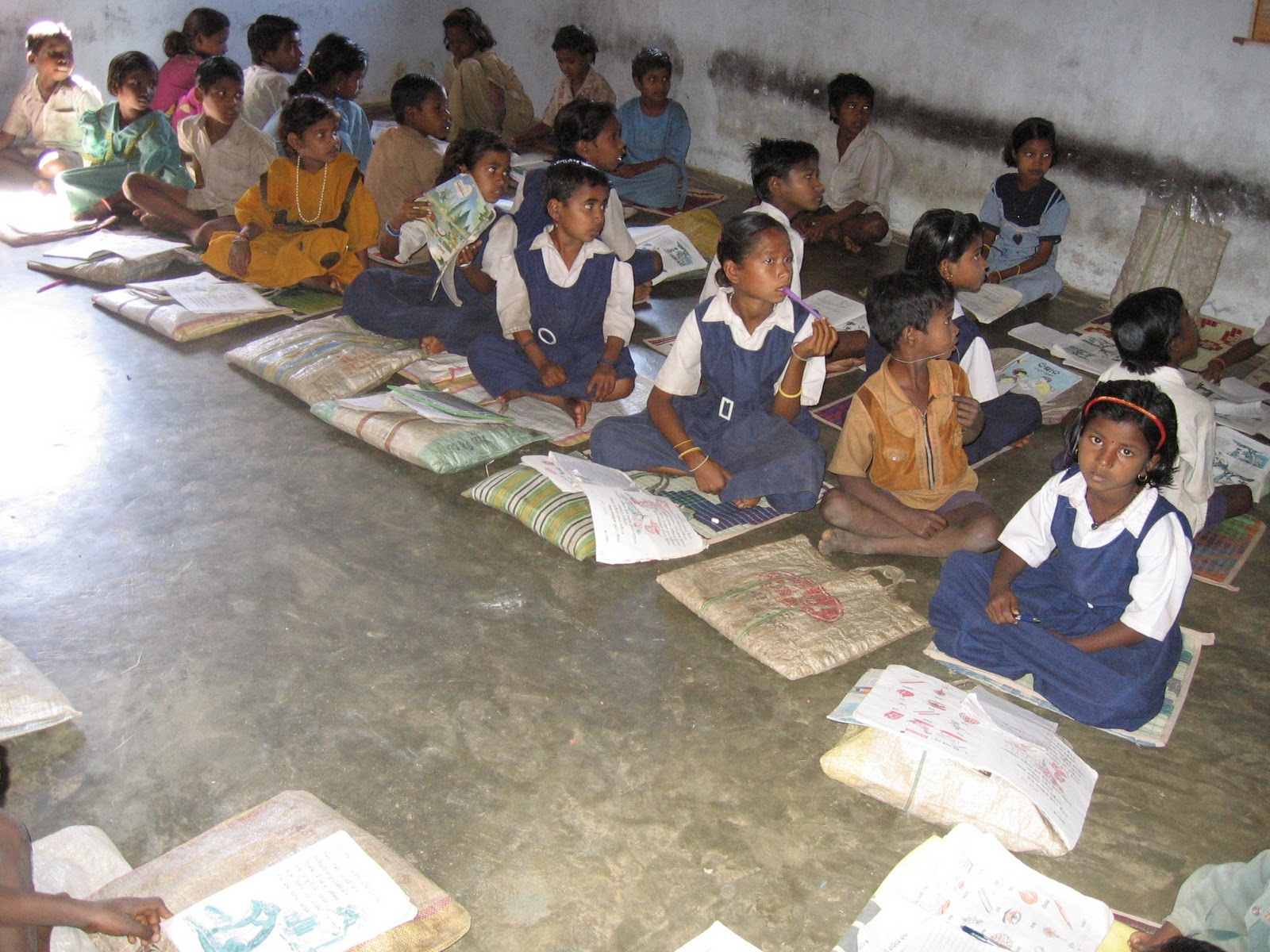
These images capture the teachers' attempts to generate the appearance active learning without actually teaching in this way (on a daily, regular basis). At least this is my reading of the pictures. What do you think? Are these teachers really running active classrooms where children will learn well? And what would you do if you were on hand to help the teacher?
Image 1
Such large groups - is there any scope of getting any work done?
And even the books cannot be opened fully.
Surely this is 'whole-class' disguised as 'group-work'?

Image 2
What can these children do other than listening to the teacher?
How can it be re-organized?
And what kind of activities would be appropriate for this age group?

Image 3
This teacher has three different age groups and no real clue about
what to do. What should he do?
Suggestions desperately needed.

Image 4
These children have clearly never had any real engagement in learning.
They are used to sitting like this for long durations, meekly doing nothing.
What would you do if you were a
CRC-BRC member visiting this school?

Image 5
This is the same school as in Image 4, only with a different and older group.
Unfortunately this is a very, very common sight.
If you had a hundred such schools in your block,
what would you do?
Saturday, October 16, 2010
Are You An 'Education Survivor'?
If you're reading this you obviously went through the education system. And maybe you are among those who are grateful that your school days were lovely. And that what you learnt is being put to use every day.
Or maybe not.
Conduct a group discussion with people (friends, colleagues, family members), around their school days. You will find a mix of smiles, frowns and giggles -- and the frowns will usually be about their experiences inside the classroom. Almost everyone has a story of how they were wrongly punished or discriminated against or didn't receive their just dues for something or the other. Around half the people will recall the oppression they felt at different times -- examinations, punishment being handed out, the subject/s they could make neither head nor tail of, the quiet acceptance by their families that they would be mediocre and their own realization that they would not be 'good enough' in a number of things.
Cut to the present, and many of them (now quite successful in life) will also be saying : "Why did we learn all those things? And even what I studied in college, what am I doing with it now?"
These are the symptoms of the 'education survivor'. Are you one of them? Are there really as many of them around as my dire prediction indicates? Is it only our tendency to wallow in self-pity? Or just the usual, superficial user-critique of education? Finally, is school education really something like a dreadful disease (or at least a dreadful experience) which leaves behind 'survivors'?
Wednesday, October 13, 2010
Listening Workshops - Or the Simplest Step to Educational Reform
Is 'bottom up' change really possible?
If you are an educational functionary, by now you must be fed up of hearing how planning and change have to be 'bottom up'. By which is usually meant that those who are 'under' you must somehow begin to contribute, own and implement a range of actions. And you inwardly wonder if this is ever going to happen!
It was during a discussion on precisely such views that the idea of a listening workshop emerged. Colleagues in the Institute of Educational Development (IED) in BRAC University, Bangladesh felt that a 'listening workshop' might help them understand teachers and grassroots functionaries better.
Listening workshop - a straightforward structure
It was agreed that before forming any views, it is critical to simply listen to teachers and head teachers. Hence a straightforward meeting / interaction / workshop was designed around the following three questions that would be asked of teachers and head teachers:
It was also agreed that IED colleagues initiating the discussion would only listen, and not prompt or provide leading questions or offer any comment from their side. In other words, they really had to listen rather than talk!
So why is all this worth writing about? Because around ten such listen workshops were actually conducted, and most turned out to have a very interesting pattern, followed by an unexpected twist.
What teachers felt
The listening workshops, it transpired, tended to proceed in the following stages.
The teachers' replies have of course begun to inform the work of the institute in many ways. However, it was the completely unanticipated outcome below that left everyone (cautiously) elated.
The unexpected 'reform'
In the case of a large number of teachers who participated, a few days after the listening workshop it was found that they were implementing many new pedagogical actions in their classrooms! In the entire discussion, at no point had they been asked to make any improvement in their classrooms. So it was not as if teachers did not know improved methods - a large number of in-service interactions had ensured that they had had exposure. It's just that they were not using them. But for some reason the listening workshops triggered a change process in the classrooms!
What do you think this tells us about teachers, about their motivations, and about the kind of relationships they experience? If you can bear the initial first hour, isn't holding a listening workshop the simplest way to initiate educational reform at the local level?
If you are an educational functionary, by now you must be fed up of hearing how planning and change have to be 'bottom up'. By which is usually meant that those who are 'under' you must somehow begin to contribute, own and implement a range of actions. And you inwardly wonder if this is ever going to happen!
It was during a discussion on precisely such views that the idea of a listening workshop emerged. Colleagues in the Institute of Educational Development (IED) in BRAC University, Bangladesh felt that a 'listening workshop' might help them understand teachers and grassroots functionaries better.
Listening workshop - a straightforward structure
It was agreed that before forming any views, it is critical to simply listen to teachers and head teachers. Hence a straightforward meeting / interaction / workshop was designed around the following three questions that would be asked of teachers and head teachers:
- What do you really do? Exactly what does your work involve?
- What do you like doing?
- What do you find difficult or dislike doing?
It was also agreed that IED colleagues initiating the discussion would only listen, and not prompt or provide leading questions or offer any comment from their side. In other words, they really had to listen rather than talk!
So why is all this worth writing about? Because around ten such listen workshops were actually conducted, and most turned out to have a very interesting pattern, followed by an unexpected twist.
What teachers felt
The listening workshops, it transpired, tended to proceed in the following stages.
- Teachers found it really difficult to believe that anyone could come down from the capital only to listen to them! There had to be a 'hidden conspiracy' or an 'agenda' they were not aware of... It would take anywhere from 40-60 minutes to convince the participants that the intention really was to listen to them. (What do you think this tells us about the functionaries that teachers usually deal with?)
- Once teachers believed the above, their initial reaction was that of giving vent to all their frustration and anger at 'you people who sit up there and form all kinds of views about us without ever visiting the field and observing the realities for yourself.'
- Finally, teachers would pour their hearts out on the three questions given above.
The teachers' replies have of course begun to inform the work of the institute in many ways. However, it was the completely unanticipated outcome below that left everyone (cautiously) elated.
The unexpected 'reform'
In the case of a large number of teachers who participated, a few days after the listening workshop it was found that they were implementing many new pedagogical actions in their classrooms! In the entire discussion, at no point had they been asked to make any improvement in their classrooms. So it was not as if teachers did not know improved methods - a large number of in-service interactions had ensured that they had had exposure. It's just that they were not using them. But for some reason the listening workshops triggered a change process in the classrooms!
What do you think this tells us about teachers, about their motivations, and about the kind of relationships they experience? If you can bear the initial first hour, isn't holding a listening workshop the simplest way to initiate educational reform at the local level?
The Poor Make an Educational Choice
Though it had been around for a long time, in 2003-04, a disturbing trend began to be dramatically visible in the government school system: a large number of districts began to report a decrease in the number of children enrolled. However, this decrease was not due to any slowing down in the growth rate of child population. Nor was it because accurate data was now available in place of the earlier inflated numbers. And since the number of children reported to be out of school was not increasing either, what accounted for the children missing from government schools? Yes, you guessed it – they were shifting to the ever-spreading network of the low-fee private schools.
The number of districts reporting such decreased enrolment stood at 180 or nearly one-third the number of districts in the country. Nor was this confined to the so-called ‘backward’ states – for Andhra Pradesh, Delhi , Gujarat, Himachal Pradesh, Karnataka, Maharashtra and Tamil Nadu also reported the phenomenon. In the year 2005-06, six new states reported districts with decreasing enrolment in government schools. And the situation hasn't really improved since.
The private schools that children migrate to come under the ‘unrecognized’ category, hence few government records are available on their numbers or growth. However, it is apparent that the increase in their numbers is astonishing. A World Bank study estimated that 28% of the rural population in the area studied had access to private schools in their own villages, and nearly half the private schools were established after 2000. Studies in Punjab showed that around 27% children studied in such schools and a similar picture obtained in Andhra Pradesh and Orissa.
This large-scale exodus has been occurring at a time when the government is spending an unprecedented amount of money and effort on education. Since 2000, tens of thousands of new schools have been opened in underserved areas and the infrastructure of existing schools boosted. Around 8.5 lakh teachers have been appointed and around 87% teachers in place provided 20 days of in-service training every year over the last few years.
Despite such efforts, anybody with any means whatever is choosing to walk across to a (usually) nearby school and pay for what they consider good education. This is in a context where education is available free in government schools, along with other incentives such as free textbooks and mid-day meals.
Like mobile phones, private education is no more the preserve of the elite. Surveys have found that 20% students in such schools are first-generation school-goers, with another 14% having parents with four (or less) years of education. Visits to such schools in the poorer regions of a state like UP put all doubts to rest. Without fail, it is the poor who are sending their children to schools that charge fees in the range of Rs. 30-100 a month. Schools manage this by paying teachers Rs. 1000-1200 per month – well below the minimum wage for unskilled labour. It is usually the educated unemployed who take this up as a means to gain experience while being on the lookout for other jobs. Therefore, teacher turnover is high, but there is a continuous stream of cheap labour available. The result is a commercially viable venture that provides subsistence level education.
In the meantime, who remains in the government system? For those hovering around the poverty line or below, there is no other recourse. Over 80% of SC and ST children in school are in government schools, which also have a higher proportion of girls and children with disabilities. In a telling comment, it is common for families with meagre resources to educate their sons in private schools and daughters in government schools. Indeed children are often enrolled in the government schools (for entitlements such as mid-day meals or uniforms) but actually attend the nearby private schools (for education)!
Unfortunately, the exodus of the more powerful and influential families has led to a greatly reduced sense of accountability in government schools. Those who are ‘left behind’ are usually the more disadvantaged groups, already disempowered due to economic and social reasons. Teachers, school heads and education officials tend to feel that it is almost ‘pointless’ to serve ‘these people’. In fact, a common refrain across the country is to complain of the ‘poor stuff we get to teach’ (and by 'poor stuff' they mean children!). There is an increasing tendency to blame the poor for not being able to support their wards at home or provide educational resource and the like. What is forgotten in all this is that education is not a favour being done to the poor – it is their right!
This is perhaps one of the reasons why the dramatic increase in inputs into the education system has not led to outcomes in terms of children’s learning levels, which continue to remain abysmal. Surveys by the NCERT and the NGO sector have repeatedly brought out how only half the children seem to learn half of what they should! During field visits to government schools, it is very common to come across children sitting unattended in class, with the teacher either absent or simply not teaching. Often, of course, the teacher has more than one class to handle and is therefore unable to teach. However, it is the sheer lack of concern for children that strikes any observer the most.
Many take the view that the expanding number of private schools is contributing to universalisation of elementary education in the country. While that is certainly true to an extent, a greater impact seems to be that in leading to reduced accountability, private schools are also contributing to a reduction in the government’s ability to universalise education in its own schools.
Sunday, October 10, 2010
Over-aged -- and loving it! -- Part 1
It's difficult, but imagine for a moment that you're an 11-year-old who wasn't able to attend school. When you were very young, you can remember, your parents moved from place to place, working on construction sites. A few years ago, they got work back in your village as a canal made agriculture more possible. And you yourself started off being an assistant cattle-herder. Now, though, you've graduated to full cattle-herder, with knowledge of all the grazing areas, the watering places, the dangers to look out for (that unexpected ditch into which all the young cattle are always falling) and the idiosyncrasies of owners who don't always pay on time. As you saw children going to the nearby school carrying weird little bags or screaming insults at you, you wondered what they did holed up the whole day in that building. Even the cattle seemed to be more free than they.
Then one day, the newly appointed teacher organised a meeting with all community members and explained to them something called 'Right to Education'. Basically, this meant that your parents decided you should go to school. No one asked you. Your father only said, 'Now work is more regular here, we can manage.' So off to school you were dispatched. Being alone with a hundred cattle in the nearby jungle (with the possibility of that nasty jackal) seemed so much less fearful than entering that stark building, all yellow and white with blue things written on it here and there.
What are the children in there going to say? Your mother made you have your bath and put on the other pair of clothes, so no one would say you smell -- but the beloved odour of cows isn't going away from you and your clothes anytime soon. There are some green-painted metal play things on small play ground. The smell of food being cooked mingles with the smell of something else (it's paper and chalk and sweat, though you don't know it yet). Your heart is in your mouth as you step onto the ramp climbing up to the school. The teacher comes out and is looking at you -- and you're doing your best not to run away. Away, back to the beloved forest, with the hundred cattle who know you so well.
Friday, October 08, 2010
The Top Ten Confusions in Education
Trying to improve the quality of education - be it in a school or a cluster or an entire system - can be full of 'land-mines' exploding unexpectedly, leaving you with confusion all around you. Here are the top ten 'confusion' land-mines:
Actually the list is longer than ten - pick out your own top ten! (You can include ones that are not here)
Also, who's the one confused? You, or the others? And is there anything that can be done?
- It is only when I teach that children will learn, isn't it?
- Don't we have to guide children and show them the way?
- I'm not biased, am I?
- Can all children really learn?
- We can't teach different children different things in the same classroom, can we?
- If only the teachers started working, wouldn't all problems of school education be solved?
- If I turned out OK, how can there be much wrong with the education system?
- If children start thinking by themselves and 'constructing' their own knowledge, what is the role of (and the need for) the teacher?
- If we don't discipline children and correct their 'errors', won't they turn out bad?
- Isn't the curriculum the same as the textbook that has to be 'covered'?
- In-service teacher training workshops can transform teachers, isn't it?
- Testing is the best and the only way to find out if children have learnt anything, isn't it?
- If one's education doesn't help one get a job, what good is it?
- Researchers and academics know best about classroom processes, don't they?
Actually the list is longer than ten - pick out your own top ten! (You can include ones that are not here)
Also, who's the one confused? You, or the others? And is there anything that can be done?
Missing the Aim(s) of Education!
Or the Adventures of a Curriculum Developer
It's a perennial struggle to define what we really want out of education. That is, it is a struggle for those who are vested with the responsibility of developing the curriculum, materials, evaluation and the like. For others, such as parents, things are reasonably clear. Which is where part of the problem lies.
The common man, or the consumer, or the parents of children who come to a majority of our schools, have no doubt at all that the purpose of education is to prepare children so that they can get a job (and be a worry off their heads). Many others – such as owners of private schools – boast that they get hundred percent results in the various examinations. Implying that the purpose of education is to get children to pass through examinations with flying colours (and what the purpose of the examinations is of course well known to all!)
And if you ask teachers in government schools, the ones who actually teach and are considered 'sincere', they will usually come out with statements such as: 'to develop a citizen, for all round development, someone with values, someone who can be called an educated person.'
But when it comes to developing the curriculum we are somehow so reluctant to agree with these commonly held perceptions. We want something better, higher, more durable (our own approximation of the Olympics motto?) 'To produce someone who has a deep sense of values' is one of the most common aspirations. But what kind of values? And what to do about the fact that values are so relative (e.g. in certain situations, you actually get a medal for killing a man!). What is needed in order to be able to exercise values appropriately in a contextual and relative manner? And is that more a cognitive rather than ethical function (e.g. identifying options, weighing them against each other on various criteria, etc.)?
'Education should develop the right kind of sanskars / culture in the student' is the next most popular choice. But whose culture are we talking about? A teacher trying to teach children how to use a handkerchief to blow their nose was left aghast when they reacted with amused horror as he put his handkerchief back into his pocket – they said they always threw things away after blowing their nose with rather than putting them back into their pocket! In a context as diverse as ours where the good manners of one group are easily the bad manners of others would we not end up simply extending the social control of dominant cultural group/s?
Unable to resolve this we move to discussing: what kind of society do we want to see? What would we consider a developed society? Where everyone has a job and the per capita income is high (back to jobs as the most important criterion?). Slowly the discussion moves to recognizing the diversity in society and the need for each group / person to respect the 'other' and cherish, even celebrate this diversity. The need for a dynamic society that is able to overcome the divides of caste and class, race and gender is emphasized. A society where collaboration is valued and practiced, where resources are more equitably distributed and opportunity is available to each person to better his or her lot is portrayed as the desired one.
So what are the qualities needed in the children emerging from our schools in order that this vision come close to reality. Now a little more concrete set of indicators emerges – self-confidence, autonomy, decision-making ability, the ability to accept one's own shortcomings and confront / improve them, a more scientific attitude that helps them question given conclusions and arrive at their own inferences, and so on.
So how would this impact the subjects we are teaching? Here again we run into difficulties – since, despite our best efforts, we continue to be the prisoners of our past. The kind of ideas that come up are: include a lesson on self-confidence and one on self-dependence as well, have guidance and counselling, do scouts and guides' activities, and the like. As if a lesson in self-confidence or the description of a great person's life will help attain self-dependence!
When this is explored further, the true import of some of these 'small indicators' begins to sink in. To ensure that children develop self-confidence, for example, they need to experience challenges as well as successes, repeatedly. This will generate the necessary self-belief. Clearly, then, instead of simply teaching in the regular way and appreciating the child's efforts, the teacher instead needs to challenge the child – by introducing tasks of which some part children can do, along with others that they would find difficult. Then it would be important to ask children to plan it by themselves, share and justify their plan to a larger set of friends and finally implementing it on their own. The experience of this implementation needs to be discussed so that lessons may be drawn for the next time. It is repeated experiences of this kind that lead to self-confidence.
For each of the changes / developments we want in our children, identifying its implications is a harrowing task. Not only is it difficult to know what to do so that the desired outcomes happen (e.g. how do you 'teach' to accept one's limitations and also go beyond them?), the emerging discussion tends to doubly challenge long-held notions and deep-rooted practice. (Such as supporting children as they learn on their own rather than teaching them as we are used to.) And if these are the qualities we desire in our children, we are really left wondering why it is that we should be teaching things such as physics or chemistry or past participle and geometric progression.
As we progress further in defining the aims of education, we seem to be moving further away from 'education' itself as we know it and into something that is still quite undefined and yet to be evolved. Somehow even as we define the aims, we seem to be missing them.
Thursday, October 07, 2010
Using Performance Standards to Improve Teacher Effectiveness
Here are some of the key principles that emerged from the ADEPTS experience over the last few years. ADEPTS (or Advancement of Educational Performance through Teacher Support) is an approach or a way of working, based on the use of performance standards. [More details and the standards themselves can be shared with those interested! In the meantime, here are some of the insights that emerged – feedback and your views are welcome.]
- The most important way to generate teacher motivation is to enable them to experience success in the classroom. Hence a set of minimum enabling conditions being in place make a huge difference.
- Teachers change when they experience the standards, rather than simply being told about them – towards this, the in-service courses themselves need to incorporate the standards expected of teachers. (A few of the states have begun this process of improving their own inputs to teachers.)
- There is a sequence in which teachers learn (and indeed institutions and systems learn). It is also better to avoid overcrowding expectations. It would therefore be best to plan improvement in terms of stages of teacher development, broken down into three-month phases, each of which has a very limited number of indicators to be attained (4-8). As teachers attain one set of indicators, this motivates them as well as prepares them for the next, higher order, set. The support institutions, too, learn along with the teachers and grow phase-wise in turn.
- Standards and indicators can tend to be vague! It is important to convert them into concrete steps that can actually be implemented by teachers. Thus, if an indicator agreed upon is ‘children ask questions freely, without fear’ there is a need to make clear exactly what the teacher needs to do for this to happen. Hence, as part of the roll out, all teams need to detail the concrete steps involved in converting the expectations into actionable steps.
- Implementer choice and partnering with teachers is more likely to yield results than passing on a set of instructions. In sub-district meetings, teachers should get to choose the indicators they want to attain (from a given list of potential indicators for that stage, though) and identify / develop the steps needed to attain these. Their performance will be assessed against the indicators chosen by them. If possible, peer assessment will be introduced.
- ‘Target setting’ in terms of the degree of improvement in performance can now be practiced. Teachers and their resource persons can use the standards document to fix the degree of change they seek to bring about over, say, a year or six months. They can then assess their progress against this. As this was not possible earlier, improvement efforts tended to lose their way very soon.
- Taking a ‘low-interference’ approach helps – that is, there is no pressure on the system to change curriculum or textbooks or introduce new model of teaching. It is more a case of ‘doing the same as before, but a little differently’; this reduces systemic stress and enables rapid implementation.
Subscribe to:
Posts (Atom)