Showing posts with label children. Show all posts

Friday, January 26, 2018

Do we even know what we assess when we assess learning?


‘It took me quite some time to get the little girl to let me know what was bothering her,’ said Prof. A. K. Sharma, the former Director of NCERT. The year was 2000 and he was telling me about an incident from a class 2 maths period in the model school in the NCERT campus. The teacher had just completed teaching children subtraction of two-digit numbers with ‘borrowing’, and he had found two children hesitating over the problems they had been given to solve.

The first, a girl, had made a ‘mistake’ as she had failed to borrow from the tens side. Being a grandfatherly and kindly figure, he was able to cajole the girl to speak up. Very softly, looking down and away from him all the while, she said, ‘We learnt in the moral science class that borrowing is bad.’

Reeling from this, he approached the other child, a boy, and discussed why he had not completed his work on the problem. After much exchange, the boy said, ‘But why should I borrow 1? I want to borrow 2.’


Taking part in a recent session on ‘error analysis’, I was reminded of Prof. Sharma’s advice to engage with children to understand their ‘errors’ rather than rely on their work on paper. In numerous assessment experiences since, I’ve seen children who are otherwise very competent falter because of an issue at home or a fight with a friend or because they are being bullied. In open-ended questions in language, teachers are hard put to identify if there really is an ‘error’ or if the child’s view is a valid, logical interpretation. (And asking only close-ended questions is hardly sufficient to understand children’s abilities.) It becomes even more difficult when it comes to children from marginalized backgrounds – as they encounter discrimination and even denigration (of their background, language or culture), they often resist by ‘not-learning’ or do not answer out of fear of being ‘disciplined’.

As the evaluation industry expands in the Indian context with more and more professionals taking in rigorous analysis of children’s responses and analyses of their ‘errors’, the tendency is to interpret these within the framework of the subject for which the test was conducted. But do we know what we really assess when we look closely at children’s responses? What if it’s not a maths or language issue but something else altogether?

Wednesday, March 26, 2014

The Three Simplest, Least Expensive Ways To Improve Learning In Children

What's the simplest, least expensive way to improve learning in children? Here are three such. They cost you no money, and are entirely in your control. They do involve technique, but not technology. However, they don’t involve working extra hard (just changing what you do, slightly). 

1. Smile more!
This has to be the least expensive and most effective. Smile. Look at children and smile a happy smile. You’re lucky to be with them. And smile the one that glows in your eyes – all children have an inbuilt ability to know when you’re only pretending.

And what should you do after smiling? Well, nothing special, just keep on doing whatever you were doing – teaching or taking children out or organizing the morning assembly or the mid-day meal or asking them to come back into the class. Smile.

And let me know after three months about the improved learning in your classroom. As they say, you need neither money nor orders to do this.


2. Talk with children. And listen more
We have so much to tell children – instructions, information, questions, answers. But all this is not equal to talking with children. Real conversation requires taking an interest in the lives of your students, interacting with them about things that matter to them, and above all – listening to them. If you are the kind of teacher that children can relate with and say what is in their minds, you’re well on your way to improving learning in the classroom.


3. Ask yourself what you would like if you were the child in front of you
We were all born as babies and spent a fair amount of time as children. Unfortunately, we grew up and became adults. We forgot that delight which gripped us when something new or challenging or interesting was put before us. We lost track of that person in us who would not give up something engaging, no matter what. And of course we fail to recall how much we enjoyed learning something, especially when we did it on our own, whether it was cycling or reading a book to figure something out or in the sports field.

Now that you’re a teacher, it will really help if for a moment you put yourself in your students’ place. What would you really enjoy being engaged in most? What way of presenting or unfolding the learning objective under consideration be most involving? How could you get children themselves to do and think more?

This is neither as difficult or crazy as it sounds. In fact, it’s much simpler than taking the usual role of doing all the work yourself – explaining, showing a picture, using the blackboard, thinking of examples to give – while children are simply sitting around watching you! In fact, this is also what you are supposed to do – i.e. use activity, exploration, projects and other similar means.

How difficult is that? Not so difficult that it can’t be done. There are many, many sources for you to draw upon, as there are many in-service training and materials available for you. And just in case there aren’t, do let me know.


In the meantime, I hope you’ll make vigorous use of these three simplest, least expensive methods – and really boost learning among your children.


Saturday, January 29, 2011

When Is It GOOD To Get Angry?


Have you ever noticed that we get angry (or at least show it) only with those who we think are weaker than us? Thus it seems OK for parents or teachers to be angry with children, for officers and trainers to shout at teachers. But if children are angry with adults, even if they are in the right and the adult is in the wrong, it is considered NOT OK! And teachers, when upset with their so-called 'superiors' either keep quiet or make some sort of mild protest. Only occasionally does it boil over, and when it does, it is again considered NOT OK!

So what is the view we should take? Is it a good idea not to get angry at all? This is the advocated position of many. In fact there are training programmes (including those for teachers) on anger management (i.e., about managing the anger we show to those who we consider our 'inferiors'). These include things called 'positive discipline' and 'emotional punishment' – as if it is OK to do the same old thing in another way.

 In case this is not clear, the 'same old thing' means the belief that it is OK for adults to have power over children, or for some to be considered 'superiors' of others. The 'anger management' and 'positive' approach does not question this right to discipline or punish – it only says 'do it less violently please, but do it because you have a right to do it.' Something wrong there, isn't it?


The other approach would be – get angry wherever you should! That is, if you are in the right, get angry with your boss or with the adult (if you are a child or an adolescent), if they are in the wrong. Do I hear you clicking your tongue again? Something doesn't sound QUITE OK about this, isn't it? How can those who are 'below' scream at those who are 'above'? You fear it will lead to conflict, division and general breakdown of order (i.e. of who should listen to whom).

Hmm, perhaps this kind of all-round getting angry business won't really help. We're too scared of it anyway.


But it also seems there are areas where we SHOULD GET ANGRY – and we don't. When a child is molested or deprived or hurt or demeaned – we don't see much anger. When teachers who really want to teach better and teach differently are ridiculed to the extent that they give up trying to improve – we see NO anger. When a girl is brutalized (or even killed) because she refused to get married at 14, we don't seethe with anger! When an education system is run year after year and the children who've invested their entire childhood in it, emerge without any learning to show for it – we are simply not consumed with anger!

IT – IS – NOT – OK.

WE MUST – REPEAT, MUST –

GET ANGRY!


Go out. Get angry. Preserve this anger. Don't let it dry up. Spend it - drop by drop. Keep at it. And at it. Till that which makes you angry is snuffed out. Totally.

Friday, October 22, 2010

The Case for Children's News Programmes

Imagine regular news programmes for children
While advertising and entertainment programmes have begun to cater to children's needs, for some reason news channels have ignored children altogether! Imagine a regular children's news programme, at a fixed time, presented in a lively way, as something for children to look forward to daily. It could be on radio and better still, on TV.

What such programmes could contain
While national and international events would figure in it, children's news would focus on the world as seen by children. Background information would make the news more accessible, along with activities that can be done at home or school. There might even be discussions and debates on issues that children have views and opinions on, along with scope to engage with the channel through phone calls / sms / email.

Newspapers too
And perhaps newspapers would follow with some space for children's news, based on what came on TV the previous night. This would not only enable greater understanding of the news itself, it would greatly boost higher order literacy (apart from newspaper circulation). This would also provide teachers with more current material for use in different classes across a range of subjects!

Many benefits
The immediate benefits for the channels themselves would be in terms of developing loyal viewers for the future (and perhaps an expanded revenue source through increased advertising range).

However, the longer term implications for children themselves, for society and the country would be enormous.

  • Children who have had the opportunity to engage with a world beyond their immediate environment would develop cognitively and socially (well exceeding the abysmal levels attained at present!) 
  • Focusing the programming at special groups (e.g. girls, or children with disabilities or the rural poor or those who need help to learn the state language - such as tribal children - or English) would dramatically increase learning opportunities for the marginalized and the disadvantaged.
  • Wide spread use of such programmes would also help harness the demographic dividend India has at the present.

If handled sensitively, this could help create a nation where plurality is cherished and the narrow confines of identity are not allowed to become a source of conflict.

Sunday, October 17, 2010

These teachers really need to learn how to teach - HELP!

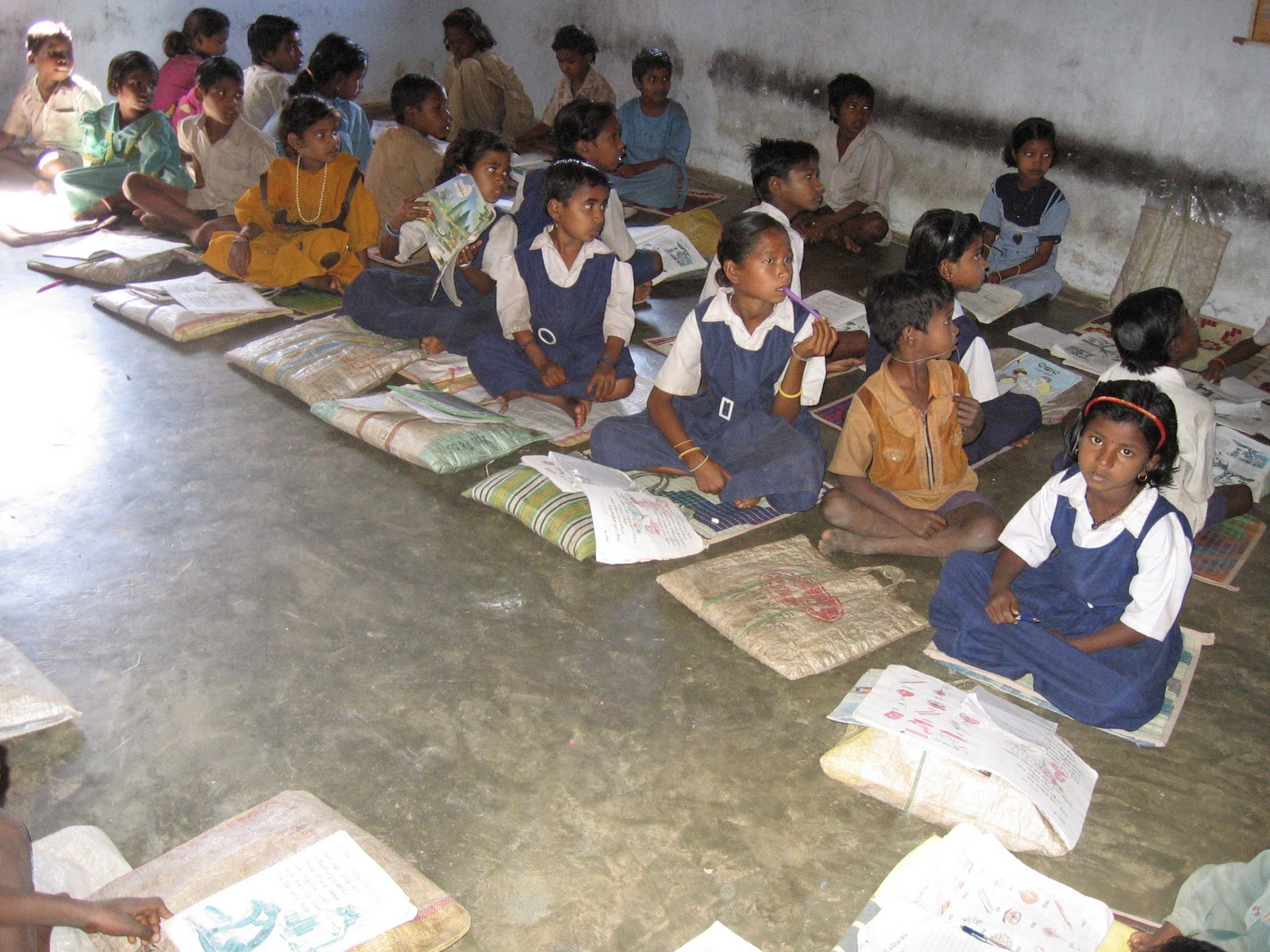
These images capture the teachers' attempts to generate the appearance active learning without actually teaching in this way (on a daily, regular basis). At least this is my reading of the pictures. What do you think? Are these teachers really running active classrooms where children will learn well? And what would you do if you were on hand to help the teacher?


Image 1
Such large groups - is there any scope of getting any work done? 
And even the books cannot be opened fully. 
Surely this is 'whole-class' disguised as 'group-work'?


Image 2
What can these children do other than listening to the teacher? 
How can it be re-organized?
 And what kind of activities would be appropriate for this age group?


Image 3
This teacher has three different age groups and no real clue about 
what to do. What should he do? 
Suggestions desperately needed.


Image 4
These children have clearly never had any real engagement in learning. 
They are used to sitting like this for long durations, meekly doing nothing. 
What would you do if you were a
 CRC-BRC member visiting this school?


Image 5
This is the same school as in Image 4, only with a different and older group. 
Unfortunately this is a very, very common sight. 
If you had a hundred such schools in your block, 
what would you do?