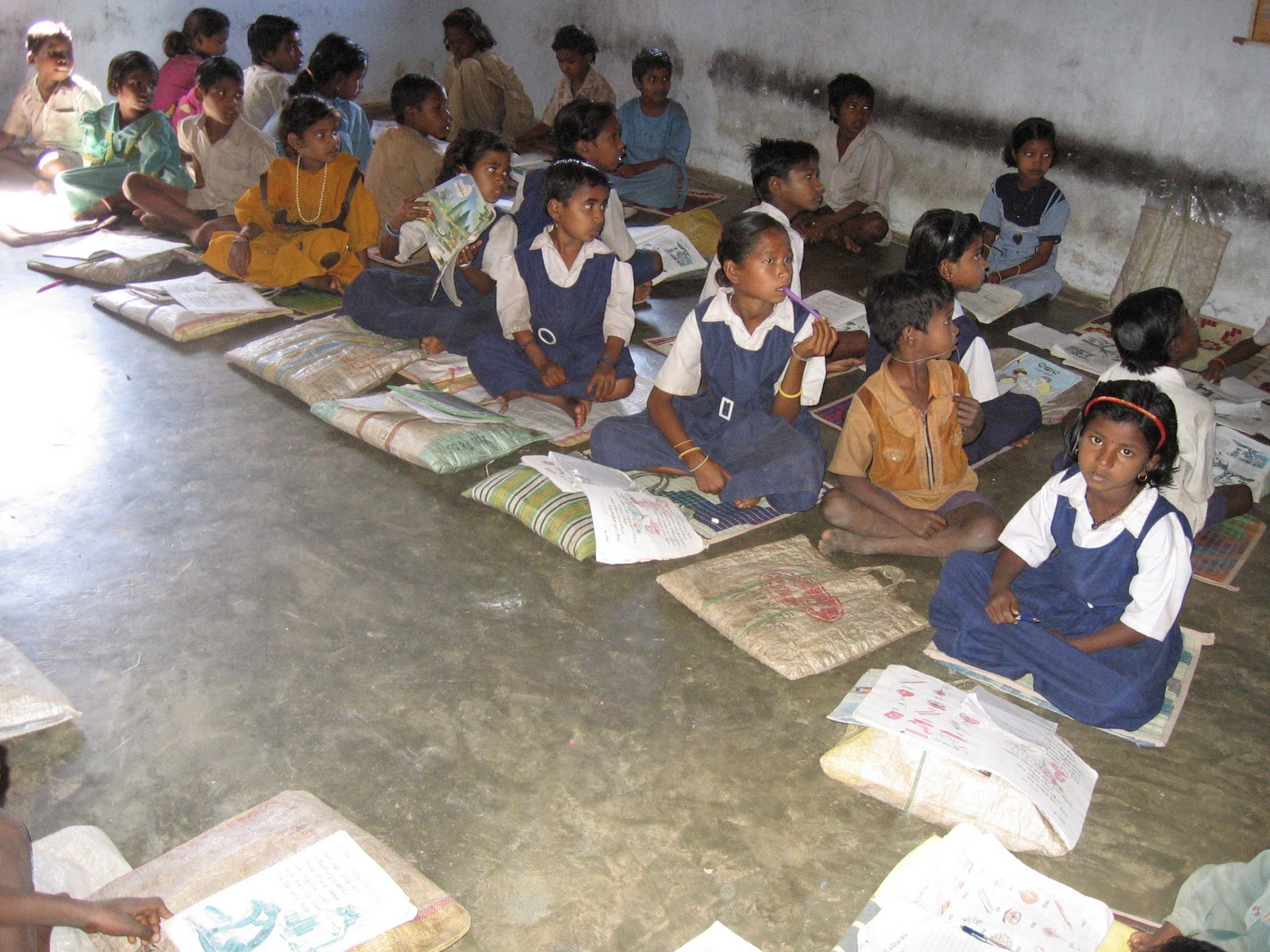
Showing posts with label child-centred education. Show all posts

Wednesday, May 04, 2016

What happens when you seriously try to empower children, teachers and community through large scale education initiatives?

The pervasive notion that 'nothing has been done in education in India' could not be further from the truth. In fact not only has a great deal been done, but its consequences have been faced over decades. In particular, what follows applies to introducing educational designs based on local context, using the experiences and strengths of the stakeholders, creating a situation where they play an active role in determining and implementing processes.

Though obviously much must have been done over the decades till the 80s, my experience ranges from mid-80s, when I was part of a team working on such classroom practices, textbooks and educational designs from 1986 onwards. Implementation of the programme called Prashika (Prathamik Shiksha Karyakram) focused on marginalised groups, with the team living in a tribal area as well as in a rural, deprived pocket and introducing the innovation in government primary schools. The work in Prashika was pathbreaking in many, many ways (integration of 5 subjects at the primary level, incorporation of multiple local languages, a hugely localised textbook/workbook that could only be completed with each child contributing, called Khushi-Khushi - still not matched anywhere, I believe). It provided hope that much was possible despite the difficulties faced and informed many of the later efforts that followed, both in the government and the NGO sector.

Later in DPEP - particularly Kerala, Assam, Karnataka, Haryana, UP, Bihar, TN, Nagaland and later with SSA Gujarat further work was done. Localised training, contexualisable textbooks (some really brilliant stuff still not matched anywhere - and that's a professional opinion), teacher determined assessment system, involvement of community knowledge, children constructing local histories / local environment books, peer learning and assessments, textbooks that would be 'complete' only along with a set of 50 district-specific books kept in the school library.... many, many innovative and large scale measures were conceived and actually implemented using a strategically developed implementation plan. 

In each first five states we were able to see 2-3 years of implementation, development of hundreds / thousands of teachers who implemented contextualised learning, a high degree of in-class practice backed by supportive, localisable material. These states changed their position in the national achievement surveys too, with Kerala rising to the top (it had been fairly close to the bottom before this, below Bihar in the first national survey). In the case of Gujarat, field testing was done in 630 schools, researched by MSU Baroda with very encouraging findings. 

However, as long as we were not visibly successful there were no problems. When change began to be visible on some scale and a palpable sense of energy was witnessed among teachers and communities, alarm bells began to ring. in each of these states, the powers that be - especially at state level, state institutions, administrations, political parties - found that this went against the command-and-control structures conducive to them being able to assert their authority. Schools didn't want to be told what to teach when and how - they had their own plans. Empowered teachers / school heads / even some VECs refused to kowtow to mediocre ideas or corruption oriented bosses - leading to huge conflicts all over the place. Unfortunately these never got reported, recorded or researched. The results were mass scale transfers, cases against state project directors who encouraged this (Kerala SPD was charge sheeted, Karnataka SPD given punishment posting in North Karnataka, Assam SPD sent to conflict zone during worst riots, Bihar SPD transferred to PHED and later kept without posting), the re-casting of State Resource Groups from those selected for tested capabilities to those stocked with ex-officio positions, the emasculation of the BRC-CRC structures from genuine teacher support institutions into data collection centres (believe it or not, we did have functional BRCs CRCs at one time!), the centralisation of powers away from the VECs and re-casting into SMCs with a different function, and major shift in recruitments away from districts to states (in one state the Education Minister held a Recruitment Mela in a stadium to personally appoint 3000 para-teachers). 


Interestingly, Prashika in MP faced a similar adminstrative backlash and was closed down.

Yes, like it or not, this is what ideas of empowerment through education come up against - and they fall short not because of lack of any purity in the idea itself or absence of rigour, but because after a point when it goes into implementation an idea is something else, and not its original pure self. You might look at the actual work and find it is not 'up to the standard' - yet when trying to create it for those who need education the most, other aspects need to be taken into account. Basically, empowering the weak is clearly seen by the strong as disempowering them - and the empire strikes back! One of the outcomes is that a few years later, it appears as if nothing has been done, and people gear themselves up to again come up with 'innovative' ideas, often weaker than might already have been tried, uninformed by the past.


Wednesday, March 26, 2014

The Three Simplest, Least Expensive Ways To Improve Learning In Children

What's the simplest, least expensive way to improve learning in children? Here are three such. They cost you no money, and are entirely in your control. They do involve technique, but not technology. However, they don’t involve working extra hard (just changing what you do, slightly). 

1. Smile more!
This has to be the least expensive and most effective. Smile. Look at children and smile a happy smile. You’re lucky to be with them. And smile the one that glows in your eyes – all children have an inbuilt ability to know when you’re only pretending.

And what should you do after smiling? Well, nothing special, just keep on doing whatever you were doing – teaching or taking children out or organizing the morning assembly or the mid-day meal or asking them to come back into the class. Smile.

And let me know after three months about the improved learning in your classroom. As they say, you need neither money nor orders to do this.


2. Talk with children. And listen more
We have so much to tell children – instructions, information, questions, answers. But all this is not equal to talking with children. Real conversation requires taking an interest in the lives of your students, interacting with them about things that matter to them, and above all – listening to them. If you are the kind of teacher that children can relate with and say what is in their minds, you’re well on your way to improving learning in the classroom.


3. Ask yourself what you would like if you were the child in front of you
We were all born as babies and spent a fair amount of time as children. Unfortunately, we grew up and became adults. We forgot that delight which gripped us when something new or challenging or interesting was put before us. We lost track of that person in us who would not give up something engaging, no matter what. And of course we fail to recall how much we enjoyed learning something, especially when we did it on our own, whether it was cycling or reading a book to figure something out or in the sports field.

Now that you’re a teacher, it will really help if for a moment you put yourself in your students’ place. What would you really enjoy being engaged in most? What way of presenting or unfolding the learning objective under consideration be most involving? How could you get children themselves to do and think more?

This is neither as difficult or crazy as it sounds. In fact, it’s much simpler than taking the usual role of doing all the work yourself – explaining, showing a picture, using the blackboard, thinking of examples to give – while children are simply sitting around watching you! In fact, this is also what you are supposed to do – i.e. use activity, exploration, projects and other similar means.

How difficult is that? Not so difficult that it can’t be done. There are many, many sources for you to draw upon, as there are many in-service training and materials available for you. And just in case there aren’t, do let me know.


In the meantime, I hope you’ll make vigorous use of these three simplest, least expensive methods – and really boost learning among your children.


Wednesday, March 14, 2012

What Do We Actually 'Celebrate' In Our Schools?

'So, you're 'celebrating' again.'

'Yes, it's Independence Day tomorrow.'

'Oh, so another round of ritualistic speeches?'

'What do you mean, ritualistic speeches?'

'You know what I mean. The same old 'important' people will be called. They will be welcomed, garlanded and they will walk around, feeling even more self-important.'

'You're being very unkind, you know.'

'But close to the truth, isn't it?'

'I'm not sure if this is really ritualistic…'

'No, it is what follows afterwards…. The same formal atmosphere will be created. Children will sit in neat rows and told not to talk too much. The LIP (or your Local Important Person) will be praised, invited to give us the benefit of his wisdom, children will be asked to shush, and then the LIP will give the same speech as every year – you are the future of the country… freedom is very important.. our great leaders were so very great… you must work hard… you must try to like the great people of the past… And all this while instead of experiencing freedom on Independence Day of India, children will be sitting bored, stiff, not allowed tomove around or talk or express themselves….'

'You're being really harsh!''

'OK, tell me, didn't you hear the same speeches when you were a child?'

'Ye-es.'

'Did you really enjoy those celebrations? Were they a celebration for you?'

'Actually, to be honest, no, not really.'

'Aren't you surprised that the same speeches are being made even now?'

'Yeah, now that you mention it…'

'And shouldn't children be more like the leaders of tomorrow rather than the leaders of long past. After all, every kid is not going to experience walking 17 kilometres to school!'

'Hmm… something to think about, there. And come to think of it, why was every great man's school 17 kilometres away?'

'See, it's getting you too!  And when it comes to – no, no, better not to say that.'

'Well you can tell me... I'm not going to shout at you!'

'I know you won't. But I don't want you to feel depressed either.'

'Come on, I can handle it. Tell me what you were going to say.'

'Well, if you insist. The thing is, children attend all these functions year after year, experience the same thing over and over again. And what do they learn? They learn that they don't matter. Their job is to listen. Their role is to be passive, not think for themselves. And look at you – you were a child who once found these functions boring but you are organizing exactly the same kind of function again! Independence Day isn't quite an experience in Independence, isn't it? My thesis is that these National Day type of 'celebrations' only teach us to be slaves, to accept that we have no freedom to be different or better, to allow ourselves to be defined by the limited vision of those limited adults who were similarly made limited by the experience they went through as children themselves…. Hey, you're suddenly very silent now. This is not look good… come on, say something.'

'What do I say? I'm feeling so…'

'So… what?'

'So depressed!'


-------------------------------------------------


What do you think about the other 'celebrations' we have in our schools? Is the birthday of a child celebrated 'more' or differently or better than that of other children whose families are considered to be less important or not influential?

What are the festivals celebrated in schools? Whose festivals are left out? Many communities / religious groups never see their festivals even discussed in school? What do they feel about it? And what do they 'learn' from this?

On Sports Day, do most children have the scope to participate and gain something? Or is only the 'victory' of a  few celebrated again and again? And what do the rest learn from this?

And on Results Day, whose achievements stand out? And what does everyone learn from this? (Maybe CCE will make a difference here?)

Perhaps all these celebrations, in the end, make us realise that their isn't much about us that is worth celebrating. When I was younger I would have said that this happens even though the intention is quite different. But now, a little more battered and older, I think the intention was always this – to make you realise that only a few can be 'important' persons worth celebrating, not you.


-------------------------------------------------

So what should we celebrate in our schools?

For starters, children and learning. Simply the presence of every child is worth celebrating (rather than 'Oh God, another one!'). And how to celebrate? By smiling, by welcoming, by genuinely talking with the child, giving space to her questions, by looking for ways to ensure she is comfortable, involved and engaged in an actual learning.

Children will ask unexpected questions, offer different points of view, find innovative ways of doing things, or help each other… celebrate this. Point out what they have done which is so good, and why it is so.

There will be times when those who usually 'fall behind' will make an effort, come up with something of their own (of course, only if you ensure they have the opportunity to do so). Celebrate their efforts, point out their good parts, and indicate what else they can do that will earn them similar 'celebration'.

If you find a fellow teacher, a staff member, a parent, an SMC member who is doing something successfully and contributing to children and the school, that's worth celebrating.

And on Independence Day? Start a few days before. Discuss with children what Independence Day means to us. Ask them how they think it should be celebrated. Come up with ideas that puts the children in the front, not adults or LIPs. Maybe they make drawings and posters related to freedom. Maybe they hold a debate on what freedom means and whether we really are a free people. Maybe they decide not to do a 'function' in the  school at all and instead spend time with children who are unable to be in school because they are not really free…And maybe they will learn something very different from such 'celebrations' than we did.

Friday, January 28, 2011

Work Smart, Not Hard!

Whenever teachers are being trained, they are bombarded with the same tired old phrases. 'You are the future of the country,' they are told. 'There's a great responsibility on your shoulders; you must work very hard to fulfil this responsibility.' This is what we hear every time, isn't it? And aren't you fed up of listening to this over the years?
     The problem is that this is such a naive notion. As if working hard makes everything OK. No, you have to use your head! Even those whose work is seen as involving nothing but hard work, they too can do their work well only if they use their head. For instance, the labourers who unload a truck, the farmer working in the field, those who dig pits or carry head loads of debris... If they do their work without thinking and being alert, they can get hurt, face a loss, be shouted at or even fired. In the case of a teacher, therefore, this is bound to be even more crucial!
     A thinking teacher - i.e. a smart teacher - is one who greatly increases children's role in the classroom. And not just in keeping things clean and organized, but in the in the learning process itself. For instance, the class 4 teacher said to the children: 'You know, in this story, when the lion woke up one morning, he found that he had no hair on his head! His mane - totally gone! So guess what he did in order to get it back? Well, read the story and find out!'
     When children started to read the story, the teacher went and sat with those who were in danger of falling behind others. After a little while she said: 'If there are any words you're not able to understand, circle them with your pencil. Then ask the children around you if they know.' When everyone had finished this, she asked groups of children to look at each other's circled words and see if they could find out the meaning. 'If there are still some words that you don't know, I'll tell you the meaning,' she said.
     You can guess what this smart teacher did next. For the entire duration that she was in her class, each child was engaged in work, was learning and helping others learn too. All this while she herself was totally relaxed!


So what are the ways in which we too can be a little more lazy, and a little smarter?

Tuesday, October 19, 2010

D for Discipline, D for Democracy!

The moment the word 'discipline' is mentioned in a gathering of teachers or educational functionaries (or even parents or community members), it acquires a special meaning, as in 'children have to be kept in discipline'. Here, the quintessential role of the teacher is that of the 'shepherd' (with stick and all), and children are seen as unruly sheep that have no mind of their own and need 'order' in their lives. I hope this sounds as dated in the reading as it does in the writing!

Perhaps this is more the case in Asian societies. Apart from most Indian states, I've found myself caught in this discussion  in Bangladesh, Afghanistan, China, Nepal, Sri Lanka, Cambodia, Laos... and there's an amazing unity of thought across these varying geographies and cultures! Children need to be guided and taught -- if their errors are not corrected as soon as the occur, it will be too late to correct them later on! (All this is said in a deep, sonorous tone to emphasize its seriousness.)

Interestingly, these are also cultures that teach you to respect your elders (whether they have any quality other than age or not!). In short, in societies where control has a role to play, 'discipline' comes to mean doing the will of the powerful (because they are adult, or older or richer or occupy a 'position'). These are also the same places where the guru or the master or the preceptor is venerated (i.e. given a status next to God herself).

This sits a little uneasily with the clamor for greater democracy in the classroom. Active / joyful learning is now advocated in most of the countries mentioned. In India, the recently enacted Right to Education actually mandates activity-based classrooms where children will construct their own knowledge. The National Curriculum Framework 2005 makes an eloquent plea for 'democracy in the classroom', where collaboration and partnership with children (rather than their 'sincerity and obedience') will be the hallmark of quality.

As you can guess, change is a long way coming. Despite the fact that democratic classrooms are 'Official Policy' backed by law, and nearly a decade and a half of yearly rounds of in-service teacher training emphasizing the virtue of active learning,  classroom teaching tends to remain teacher-directed, instruction-based, with asking questions and offering one's opinions being considered almost a sin on the part of children.

When reports last came in, thus, D for Discipline was clearly winning over D for Democracy!

Sunday, October 17, 2010

These teachers really need to learn how to teach - HELP!

These images capture the teachers' attempts to generate the appearance active learning without actually teaching in this way (on a daily, regular basis). At least this is my reading of the pictures. What do you think? Are these teachers really running active classrooms where children will learn well? And what would you do if you were on hand to help the teacher?


Image 1
Such large groups - is there any scope of getting any work done? 
And even the books cannot be opened fully. 
Surely this is 'whole-class' disguised as 'group-work'?


Image 2
What can these children do other than listening to the teacher? 
How can it be re-organized?
 And what kind of activities would be appropriate for this age group?


Image 3
This teacher has three different age groups and no real clue about 
what to do. What should he do? 
Suggestions desperately needed.


Image 4
These children have clearly never had any real engagement in learning. 
They are used to sitting like this for long durations, meekly doing nothing. 
What would you do if you were a
 CRC-BRC member visiting this school?


Image 5
This is the same school as in Image 4, only with a different and older group. 
Unfortunately this is a very, very common sight. 
If you had a hundred such schools in your block, 
what would you do?