Showing posts with label pedagogy. Show all posts

Wednesday, March 26, 2014

The Three Simplest, Least Expensive Ways To Improve Learning In Children

What's the simplest, least expensive way to improve learning in children? Here are three such. They cost you no money, and are entirely in your control. They do involve technique, but not technology. However, they don’t involve working extra hard (just changing what you do, slightly). 

1. Smile more!
This has to be the least expensive and most effective. Smile. Look at children and smile a happy smile. You’re lucky to be with them. And smile the one that glows in your eyes – all children have an inbuilt ability to know when you’re only pretending.

And what should you do after smiling? Well, nothing special, just keep on doing whatever you were doing – teaching or taking children out or organizing the morning assembly or the mid-day meal or asking them to come back into the class. Smile.

And let me know after three months about the improved learning in your classroom. As they say, you need neither money nor orders to do this.


2. Talk with children. And listen more
We have so much to tell children – instructions, information, questions, answers. But all this is not equal to talking with children. Real conversation requires taking an interest in the lives of your students, interacting with them about things that matter to them, and above all – listening to them. If you are the kind of teacher that children can relate with and say what is in their minds, you’re well on your way to improving learning in the classroom.


3. Ask yourself what you would like if you were the child in front of you
We were all born as babies and spent a fair amount of time as children. Unfortunately, we grew up and became adults. We forgot that delight which gripped us when something new or challenging or interesting was put before us. We lost track of that person in us who would not give up something engaging, no matter what. And of course we fail to recall how much we enjoyed learning something, especially when we did it on our own, whether it was cycling or reading a book to figure something out or in the sports field.

Now that you’re a teacher, it will really help if for a moment you put yourself in your students’ place. What would you really enjoy being engaged in most? What way of presenting or unfolding the learning objective under consideration be most involving? How could you get children themselves to do and think more?

This is neither as difficult or crazy as it sounds. In fact, it’s much simpler than taking the usual role of doing all the work yourself – explaining, showing a picture, using the blackboard, thinking of examples to give – while children are simply sitting around watching you! In fact, this is also what you are supposed to do – i.e. use activity, exploration, projects and other similar means.

How difficult is that? Not so difficult that it can’t be done. There are many, many sources for you to draw upon, as there are many in-service training and materials available for you. And just in case there aren’t, do let me know.


In the meantime, I hope you’ll make vigorous use of these three simplest, least expensive methods – and really boost learning among your children.


Friday, March 04, 2011

What is (more) 'Educationally Responsible'?

What is more educationally responsible from among the alternatives below. Anytime you feel it's all very clear, don't ignore the possibility that there may a trap somewhere...
  • Encouraging someone to ask questions or give answers to questions no one is asking?
  • Helping learners discover worlds of fascinating and worthwhile knowledge around them versus providing them information from books?
  • Setting challenging tasks versus 'telling' children, giving explanatory lectures ?
  • Encouraging reflection or ensuring memorization of the right answers?
  • Preventing errors or letting children discover for themselves when they've made a mistake?
  • Giving feedback versus giving marks (and remarks)?
  • Ensuring all children get the same opportunity versus ensuring different children get different opportunities?
  • Doing everything oneself (if you're a teacher) versus passing on some of your tasks to children (e.g. marking attendance, ensuring participation of peers)
  • Maintaining all provided materials in good shape or using them at the risk of their getting spoilt, torn, etc.?
  • Asking community to help with their knowledge heritage versus asking community to contribute to improvement in mid day meal?
  • Using a textbook as a resource versus using a textbook as a definitive material (i.e. assuming it is the curriculum)
  • Reading this blog or reading a useful book on education?!

So what is more educationally responsible? Let me have more such pairs / alternatives to choose from, and also your views on the above!

Friday, January 28, 2011

Work Smart, Not Hard!

Whenever teachers are being trained, they are bombarded with the same tired old phrases. 'You are the future of the country,' they are told. 'There's a great responsibility on your shoulders; you must work very hard to fulfil this responsibility.' This is what we hear every time, isn't it? And aren't you fed up of listening to this over the years?
     The problem is that this is such a naive notion. As if working hard makes everything OK. No, you have to use your head! Even those whose work is seen as involving nothing but hard work, they too can do their work well only if they use their head. For instance, the labourers who unload a truck, the farmer working in the field, those who dig pits or carry head loads of debris... If they do their work without thinking and being alert, they can get hurt, face a loss, be shouted at or even fired. In the case of a teacher, therefore, this is bound to be even more crucial!
     A thinking teacher - i.e. a smart teacher - is one who greatly increases children's role in the classroom. And not just in keeping things clean and organized, but in the in the learning process itself. For instance, the class 4 teacher said to the children: 'You know, in this story, when the lion woke up one morning, he found that he had no hair on his head! His mane - totally gone! So guess what he did in order to get it back? Well, read the story and find out!'
     When children started to read the story, the teacher went and sat with those who were in danger of falling behind others. After a little while she said: 'If there are any words you're not able to understand, circle them with your pencil. Then ask the children around you if they know.' When everyone had finished this, she asked groups of children to look at each other's circled words and see if they could find out the meaning. 'If there are still some words that you don't know, I'll tell you the meaning,' she said.
     You can guess what this smart teacher did next. For the entire duration that she was in her class, each child was engaged in work, was learning and helping others learn too. All this while she herself was totally relaxed!


So what are the ways in which we too can be a little more lazy, and a little smarter?

Sunday, October 17, 2010

These teachers really need to learn how to teach - HELP!

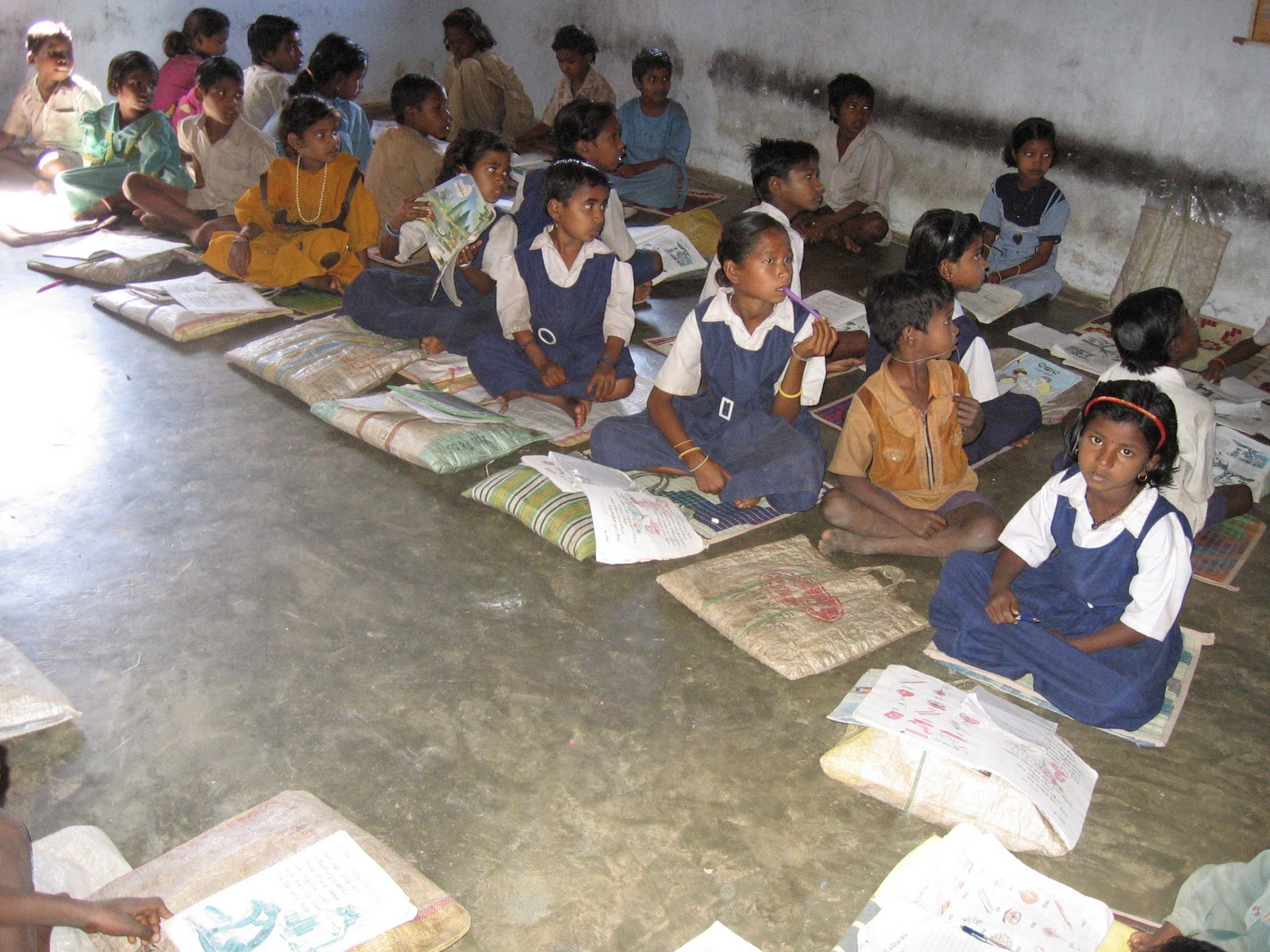
These images capture the teachers' attempts to generate the appearance active learning without actually teaching in this way (on a daily, regular basis). At least this is my reading of the pictures. What do you think? Are these teachers really running active classrooms where children will learn well? And what would you do if you were on hand to help the teacher?


Image 1
Such large groups - is there any scope of getting any work done? 
And even the books cannot be opened fully. 
Surely this is 'whole-class' disguised as 'group-work'?


Image 2
What can these children do other than listening to the teacher? 
How can it be re-organized?
 And what kind of activities would be appropriate for this age group?


Image 3
This teacher has three different age groups and no real clue about 
what to do. What should he do? 
Suggestions desperately needed.


Image 4
These children have clearly never had any real engagement in learning. 
They are used to sitting like this for long durations, meekly doing nothing. 
What would you do if you were a
 CRC-BRC member visiting this school?


Image 5
This is the same school as in Image 4, only with a different and older group. 
Unfortunately this is a very, very common sight. 
If you had a hundred such schools in your block, 
what would you do?

Friday, October 01, 2010

Cure or Prevention: the Health Education Dilemma

There is no doubt that educating children on health issues is absolutely important. But the moment we begin this, a major problem crops up. What should the thrust of health education be in a context like ours? It's not as simple as it appears.

If we were to talk of prevention, we find ourselves making invalid assumptions. For instance, we start with 'washing hands with soap regularly prevents disease'. But the problem is, say a huge proportion of children and the community, 'there is not enough water even to drink, how do we wash hands with soap?' Next we say, 'you must eat green leafy vegetables'. However, the response: 'hey, there isn't enough food to eat in the first place, let alone leafy vegetables'. The list is endless. The bottom-line: poverty is at least as important a health issue as lack of health education.

On the other hand, emphasizing prevention has its own limitations. For example, when discussing scabies it is common to find the use of neem being advocated. Though neem is commonly available, it is not exactly always useful in all cases of scabies. Medical advice should be sought rather than relying only on such suggestions. As they say, it can be dangerous to be armed with half-baked information.

So what do we do? Not talk about health at all?

No, we do need to educate our children on health. But the emphasis has to be on educate rather than merely plying them with information. In concrete terms this implies helping children perceive the causal links between different factors in their immediate environment and their health. How the body works, what it is affected by and how it responds to different factors, and how our own actions (individually and collectively) impact upon it -- these are some of the components of what contemporary health education should be like.

This would naturally require scope for exploration, projects and activities. The pedagogy involved should help children arrive at their own conclusions, especially in terms of actions they could take. Here's an example of what might be a good health education activity (for grade 3 students, assisted by their teacher):

Take two small plates -- put a little dal water in one, and a little sweet tea in the other. Set these plates in the sun and let the fluids dry. After a while, touch both of them with your fingers - one of them feels sticky and the other doesn't. Why do you think this is so?
Next, take a knife (let your teacher do this!). Cut a cucumber and feel the knife edge carefully. Now cut a piece of jaggery and feel the edge again (carefully!). Which item left a more sticky knife edge? Why?
So when we eat, which items are more likely to continue sticking to our teeth? And what will happen if they remain there (discuss with your teacher)? So what do we need to do? 

That's it. There's no need really to give a long lecture of oral hygiene, full of facts and figures and information on exactly how to hold the brush etc. etc. All that sounds so platitudinous that children instinctively 'switch off' (as do adults when lectured!). The intention is that by helping children arrive at their own conclusions, we increase their stake in taking appropriate health-related action. And hence the increased chance that the understanding will actually translate into behavior!